Could you give us some information about the standards determined for auto glass manufacture?
There are some properties that automotive safety glasses must have. There are several standards and regulations that regulate and monitor these properties. The most important and widely accepted one is called ECR 43, a regulation prepared and published by the United Nations and the European Commission. All manufacturers of automotive safety glass are obliged to abide by this regulation when manufacturing glass. Other than this, there are different standards similar to the ones in this regulation in different countries such as China, the US, South America and Japan. At Olimpia Auto Glass, we do not only comply with ECR 43 but also with the other standards in said countries when manufacturing our products.
What are the duties of the Quality Department at Olimpia Auto Glass?
As mass production continues, we, as the Quality Department, are responsible for performing the tests required by these standards. These include obligatory tests described in this regulation and standards such as fragmentation tests for tempered glass, light transmittance tests, impact tests on laminated windshields and other laminated glass, destructive inspections, optical distortion checks, and secondary image checks. If a glass cannot pass these tests, it is forbidden to be used in any vehicle. Manufacture of glass that does not meet these criteria could lead to unusual injury to passengers, drivers and third parties, and even death. We do not only ensure that the glass protects you in case of an accident but we also equip it with properties that will prevent any accident.
We are obliged to prove to the relevant approval bodies that we manufacture our products according to the standards at regular intervals. In certain periods, the TSE visits our plants in Ankara and Gebze. During these visits, they check and confirm that we manufacture our products according to the relevant standards. Similarly, for our certifications valid in other countries, we go through these types of checks and compliance audits at certain times. Other than the controls and tests stipulated by the standards, the quality expectation has increased in time both at the end user side and at the key industry companies. For this reason, other than the safety tests stipulated by the standard, it is also required to check the shape and background of the glass, and its heating properties among others through different methods. For example, the Olimpia Auto Glass laboratory is equipped with 3D measuring systems. These systems are used to check if the glasses we manufacture meet customer expectations and specifications. If an adverse event is detected during the checks, retrospective improvements are performed and it is ensured that products that meet customer expectations are put on sale on the market. Similarly, in our laboratories, there are thermal tests we perform other than the experiments stipulated by the standards. Today, most vehicles are equipped with heating systems on the windshields and rear windows. We perform thermal tests to check if these windshields/windows are equipped with the expected heating functions, if the glass removes fog, and if the windshield defrosts the ice on the vehicle in cities and countries where the temperature is very low. With the thermal camera mechanism, we test thermal properties of the glass and check if it reaches the desired temperature in the desired time.
Could you provide us with some information about the optical tests?
Optical deviations of laminated windshields manufactured as per the relevant standards and regulations, and of the tempered windshields released in certain vehicles must be kept at a certain level. To this end, we perform optical distortion tests with light systems that we have in our laboratory and that comply with the regulation. We put the glass between the checkered image projected from the light source and the light source, and we check the optical distortions on the glass through the reflection. If optical distortions exceed certain standards, it may be required to cease its production; if a lot of products have been manufactured and there were questionable products before, these may need to be checked again, and even recalled if necessary. Therefore, optical tests are very important for us, as is the case with all other tests. A potential adverse event causes a burden for us as the manufacturer. For this reason, these tests must be completed. Furthermore, as we manufacture safety parts, we need to repeat these tests at regular intervals to prevent any damage to the drivers and passengers in vehicles.
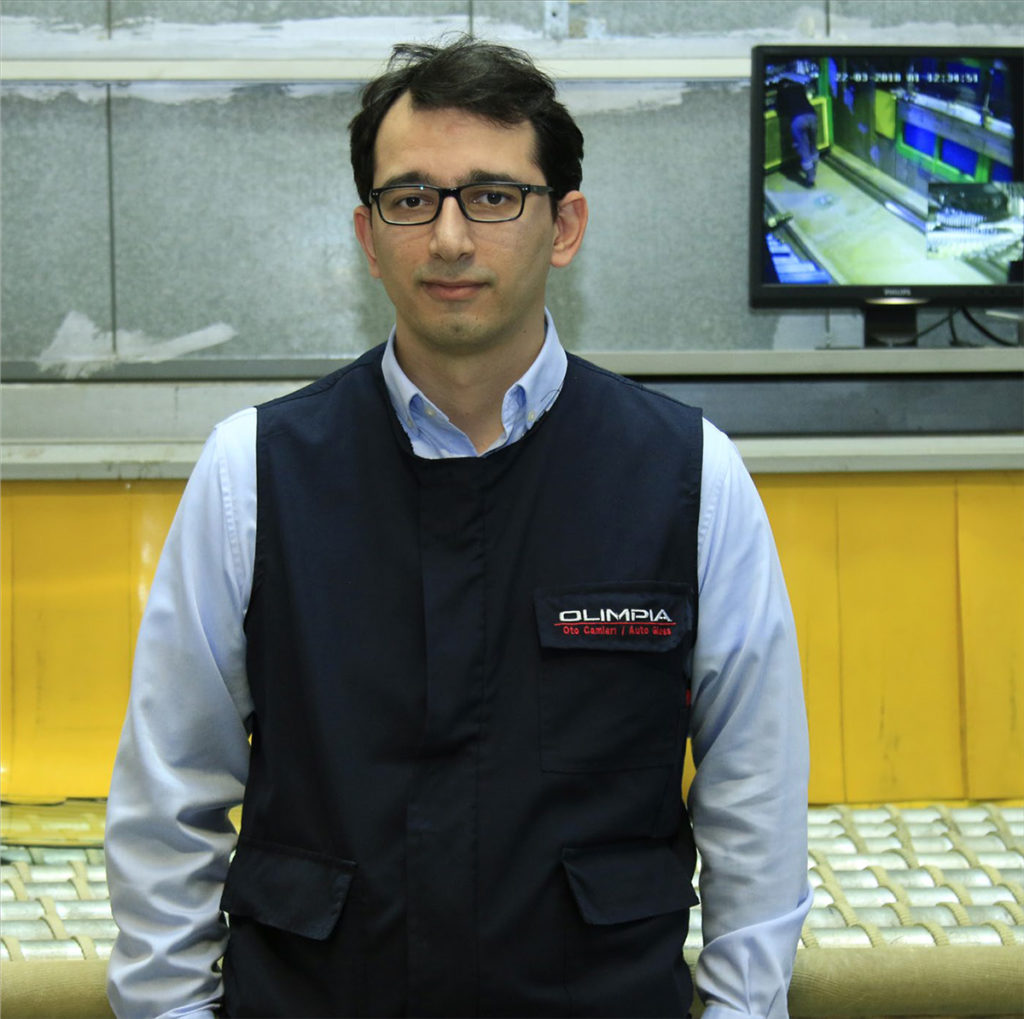
Onur ÇELİK, Quality Manager at Olimpia Auto Glass
In addition to the optical distortion tests on windshields, we perform fragmentation tests for tempered glass. During the fragmentation test, we need to break the glass to see if it is fragmented with described properties, if the number of shards is above or below a certain value, and if long pieces come out when the glass is shattered. We do this under mass production conditions while production is underway during the day, and at regular intervals with random samples.
Olimpia Auto Glass has 5 glass tempering furnaces at its plant in Gebze and 4 in Ankara. This means that we break glass of every color and every thickness during every shift at every production cycle every day, make sure it is suitable and then give approval for manufacture. Otherwise, unwanted situations may occur, and a broken glass may hit a passenger, a driver or a third person, resulting in unwanted injuries. To avoid this, we periodically perform checks and tests during production.